The Illusion of Clean: Why a Fresh Scent Doesn't Mean Clean Air
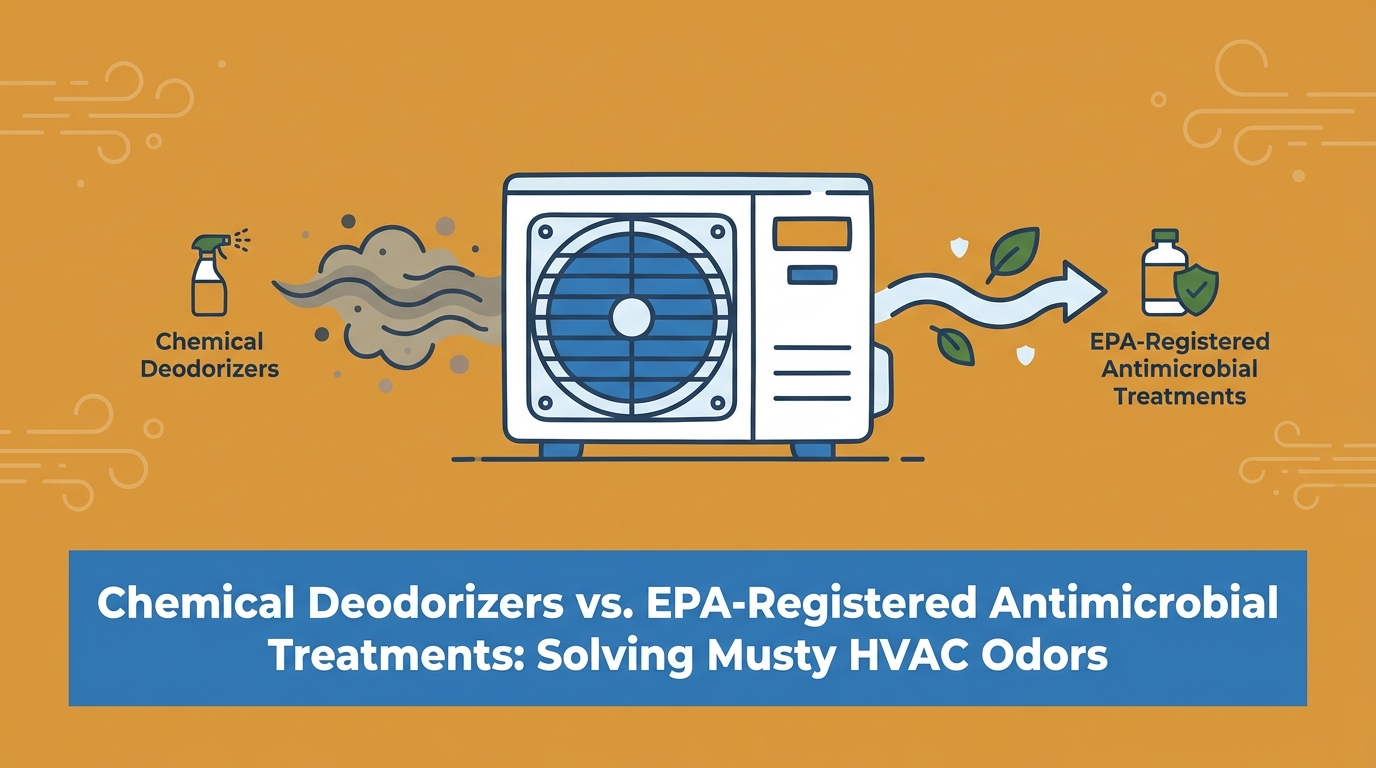
A strong blast of citrus or pine blowing from your vents does not mean your HVAC system is clean. In fact, our team at Superior Air Duct Cleaning finds that relying on artificial fragrances to cover up a musty furnace smell is one of the most common mistakes homeowners make during the early fall heating-season transition. When evaluating chemical deodorizers vs. EPA-registered antimicrobial treatments, you are facing a critical choice: do you want to temporarily mask the odor, or do you want to neutralize the biological root cause? True indoor air quality requires eliminating the source of the smell, not just overwhelming your olfactory senses with heavy perfumes.
For a comprehensive approach to indoor air quality, understanding the scientific difference between masking an odor and destroying its source is the first step toward a healthier home.
The September Surprise: What Causes That Sudden Musty Odor?
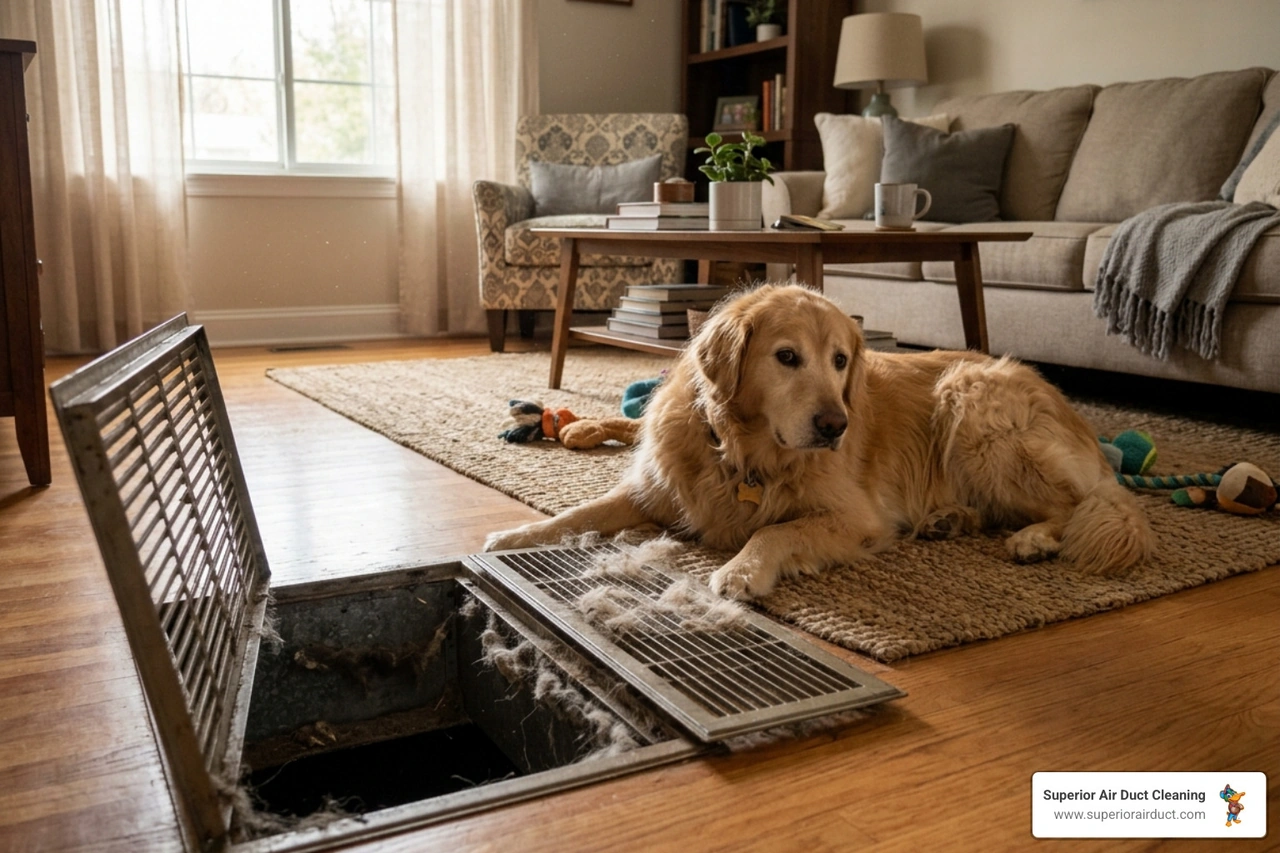
Many homeowners experience a rude awakening on the first chilly morning of the year. We often get calls right after you turn on your furnace to take the edge off the cold, and within minutes, the entire house smells like a damp basement or wet dog. This sudden, unpleasant aroma is not just "stale air" burning off the heat exchangers. It is a direct result of biological growth that has been quietly multiplying inside your ductwork for months.
The Role of Summer Humidity
To understand why your furnace smells bad in the fall, you have to look at what your air conditioning system was doing all summer. In our experience servicing homes throughout New Brighton and Western Pennsylvania, the high summer humidity provides the persistent moisture necessary for mold proliferation in dark, cool AC ductwork. As your air conditioner pulls warm, humid air from your home, condensation forms on the evaporator coil and inside the surrounding plenum. Dust, pet dander, and skin cells also get pulled into the system, creating a nutrient-rich food source. When you combine darkness, moisture, and organic debris, you create the perfect breeding ground for microbial growth.
The Furnace Vaporization Effect
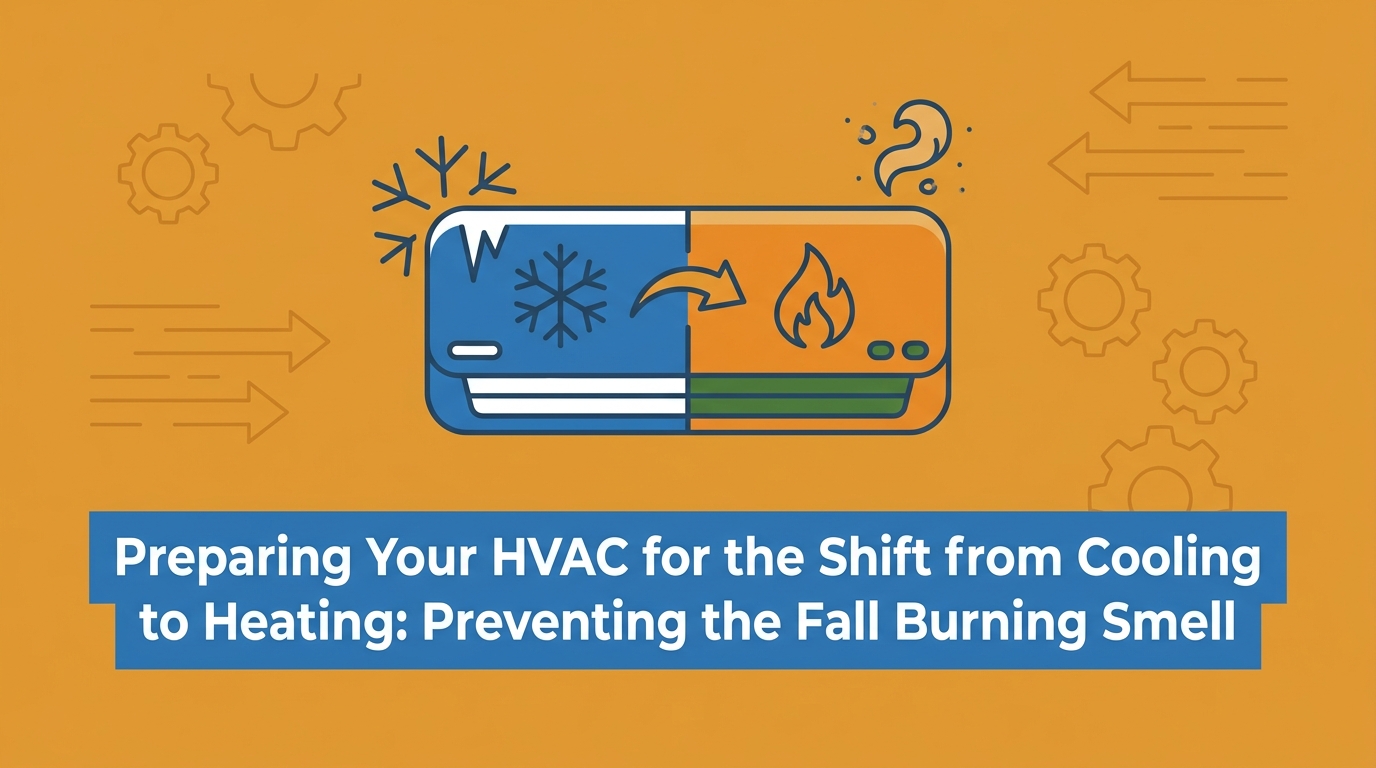
Throughout the summer, this biological growth remains relatively dormant and damp. However, when you switch your system from cooling to heating, the environment inside the ductwork changes drastically. The sudden blast of hot, dry air from the furnace bakes the accumulated microbial matter, vaporizing the dormant spores and pushing the resulting gases directly into your living space. This is the exact mechanism that creates the strong, musty smell you notice in early fall.
Before you can permanently eliminate this odor, you need to physically remove the debris that feeds the growth. Properly addressing musty odors from your air ducts always starts with a thorough cleaning by our professionals to strip away the physical buildup before any treatments are applied.
Chemical Deodorizers: Masking the Problem with VOCs
When faced with a musty-smelling house, the immediate reaction for many is to buy a quick fix. Hardware stores and supermarkets are packed with vent-clip air fresheners, aerosol duct sprays, and scented gels promising to leave your HVAC system smelling like a mountain spring. However, we always warn our clients that these products do not clean your air—they actively pollute it.
How Masking Agents Trick Your Nose
Chemical deodorizers operate on a very simple principle: olfactory fatigue. They do not remove the mold or bacteria causing the musty smell. Instead, they release heavy synthetic fragrances into the airstream to overwhelm your scent receptors. You stop smelling the musty odor because your nose is too busy processing the artificial pine or lavender scent. The underlying biological growth remains completely intact, continuing to release spores into your home.
The Hidden Health Cost of VOCs
The bigger issue with chemical deodorizers is what they add to your indoor environment. According to EPA data, many commercial air fresheners and scented products emit high levels of Volatile Organic Compounds (VOCs). These compounds vaporize at room temperature and can significantly degrade your indoor air quality. Introducing VOCs directly into your ductwork means you are forcefully distributing these chemicals into every room of your house simultaneously.
• Respiratory irritation: VOCs are known to trigger coughing, throat irritation, and asthma flare-ups.
• Allergic reactions: Synthetic fragrances often contain undisclosed chemical mixtures that can cause skin rashes and sinus congestion.
• Headaches and fatigue: Continuous exposure to heavy chemical scents can lead to chronic headaches and poor sleep quality.
Our technicians routinely see the fallout from this approach. A pattern we see often involves homeowners struggling with severe allergies and breathing difficulties, especially after moving into a new house where previous owners relied heavily on air fresheners instead of having us address the root cause. Once our team properly cleans and sanitizes the system, the air quality improves significantly, allowing for better breathing and restful sleep.
EPA-Registered Antimicrobial Treatments: True Source Neutralization
If chemical deodorizers are the wrong approach, what is the right one? The scientific answer lies in source neutralization. Rather than adding perfumes to the air, professional sanitization focuses on destroying the biological matter that is producing the odor in the first place.
What EPA Registration Actually Means
Not all cleaning solutions are created equal. When a product is classified as an EPA-registered antimicrobial treatment, it means the manufacturer has submitted extensive scientific data to the Environmental Protection Agency. The product has undergone rigorous testing to prove two critical things: efficacy and safety. It must be proven to effectively neutralize specific pathogens (like mold, mildew, and bacteria), and it must be proven safe for use in residential HVAC systems when applied according to the manufacturer's directions.
The Science of Source Neutralization
Unlike chemical deodorizers that float in the air, EPA-registered treatments attack the problem at a cellular level. These specialized solutions are designed to penetrate the cell walls of microbial organisms, disrupting their metabolic processes and neutralizing them completely. Because the source of the odor is destroyed, the smell disappears naturally—no artificial fragrances required.
This process provides long-lasting peace of mind that a cheap vent clip simply cannot offer. For example, our team recently worked with a homeowner in the New Brighton area who expressed deep concern about bacteria circulating through their ducts. By having us perform a thorough professional air duct cleaning to remove the physical debris, followed by our EPA-registered sanitizing service, the underlying issue was resolved. Reviewing the clear before-and-after pictures our technicians provided gave the homeowner absolute confidence in their indoor air quality.
Side-by-Side Comparison: Masking Odors vs. Eradicating Growth
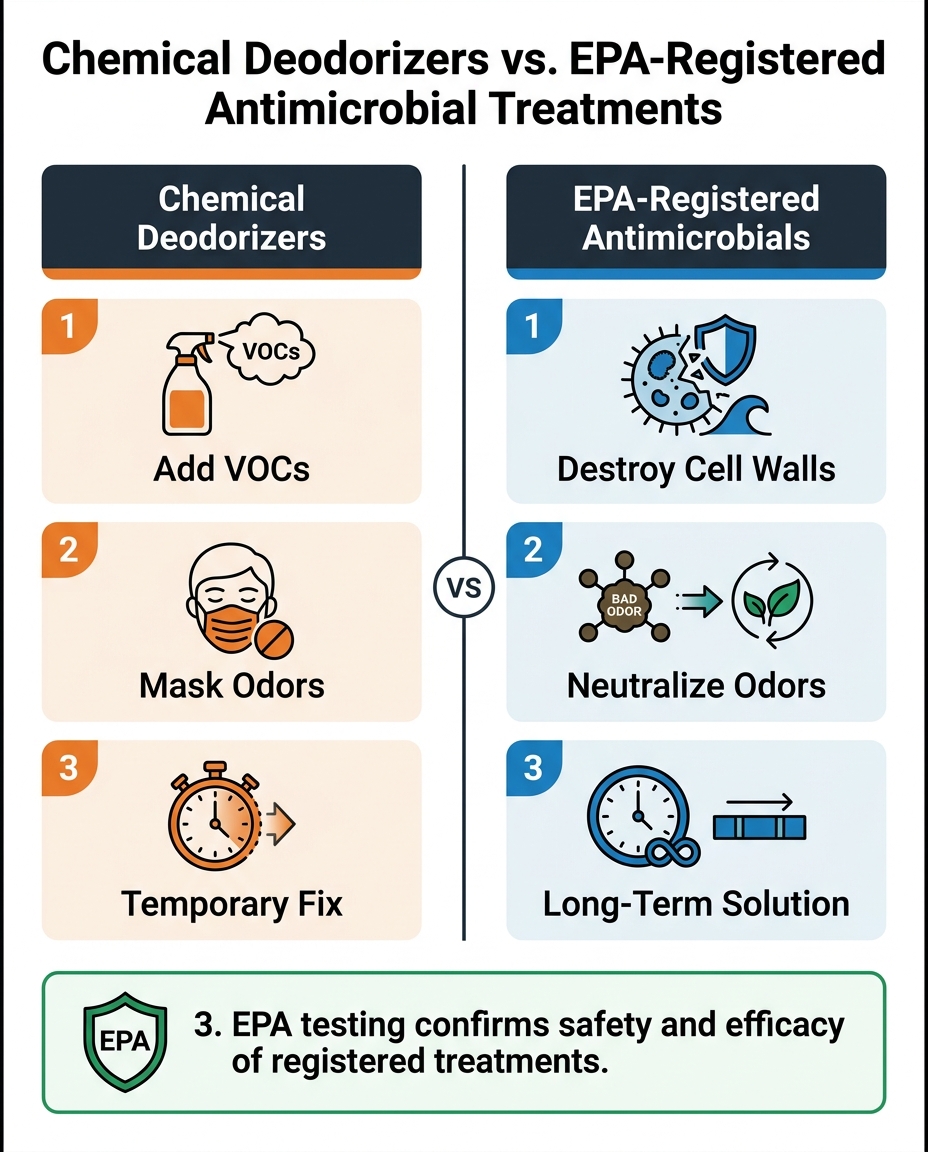
To make the best decision for your home during the early fall heating-season transition, you need to understand exactly how these two approaches stack up against each other. Review the comparison below to see why we strongly advise eradication as the only logical choice for long-term health.
• Mechanism of Action — Chemical Deodorizers: Overwhelms olfactory sensors with synthetic perfumes. — EPA-Registered Antimicrobial Treatments: Destroys microbial cell walls to eliminate the source.
• Impact on Air Quality — Chemical Deodorizers: Degrades air quality by introducing VOCs. — EPA-Registered Antimicrobial Treatments: Improves air quality by neutralizing biological threats.
• Duration of Results — Chemical Deodorizers: Temporary. Fades quickly, requiring constant replacement. — EPA-Registered Antimicrobial Treatments: Long-lasting. Prevents regrowth when paired with clean ducts.
• Safety Testing — Chemical Deodorizers: Often unregulated; contains undisclosed chemical mixtures. — EPA-Registered Antimicrobial Treatments: Rigorously tested by the EPA for residential safety.
• Value Perspective — Chemical Deodorizers: A recurring, cosmetic expense that fixes nothing. — EPA-Registered Antimicrobial Treatments: A targeted investment in household health and safety.
Why Professional Application is Non-Negotiable
Once homeowners understand the danger of VOCs and the benefit of true sanitization, the next logical question is often, "Can I just spray household disinfectant into my return vents?" The short answer is no. Attempting to sanitize your own ductwork is ineffective at best and dangerous at worst.
The Danger of DIY Disinfectants
Household aerosol disinfectants are designed for hard, non-porous surfaces like kitchen counters. They are not formulated for the complex airflow dynamics of an HVAC system. Spraying an aerosol can into a vent only coats the first few inches of the ductwork. It completely misses the deep recesses, trunk lines, and evaporator coils where the majority of biological growth thrives. Furthermore, many household disinfectants are highly flammable. Spraying them into a system that pulls air across a hot furnace heat exchanger poses a severe fire hazard.
The Professional Sanitization Process
To safely and effectively neutralize biological growth, the treatment must reach every square inch of the interior ductwork. Our certified professionals achieve this through a precise, multi-step process:
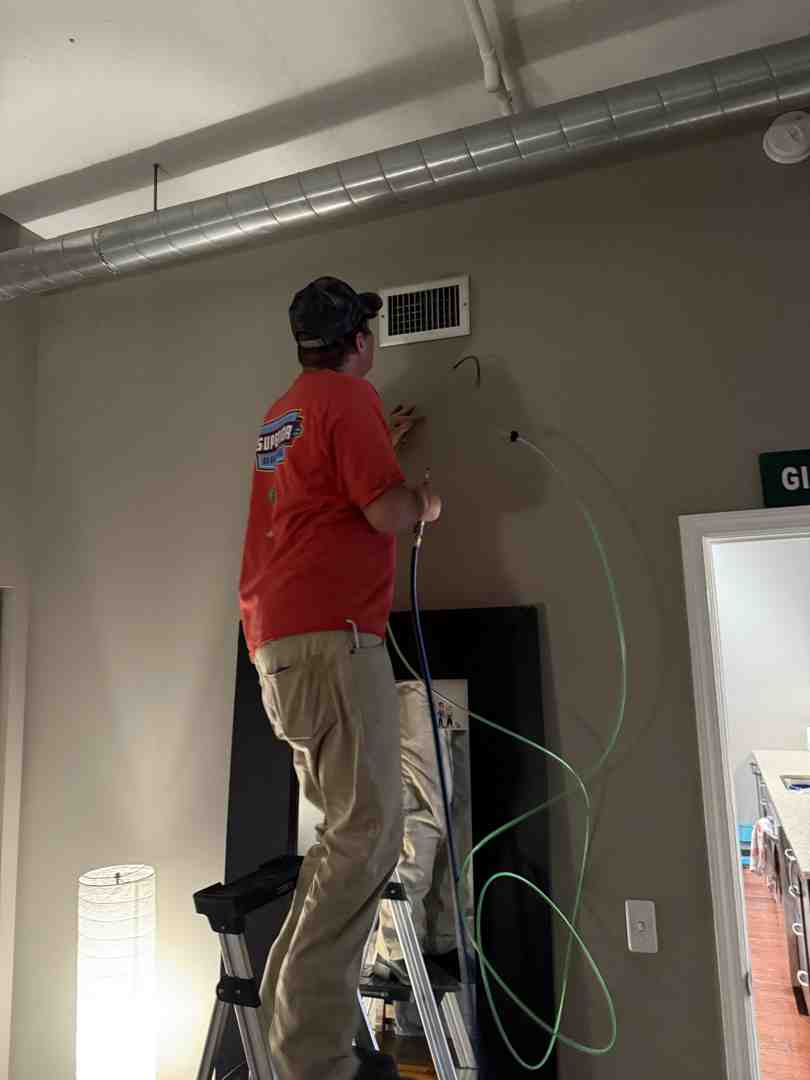
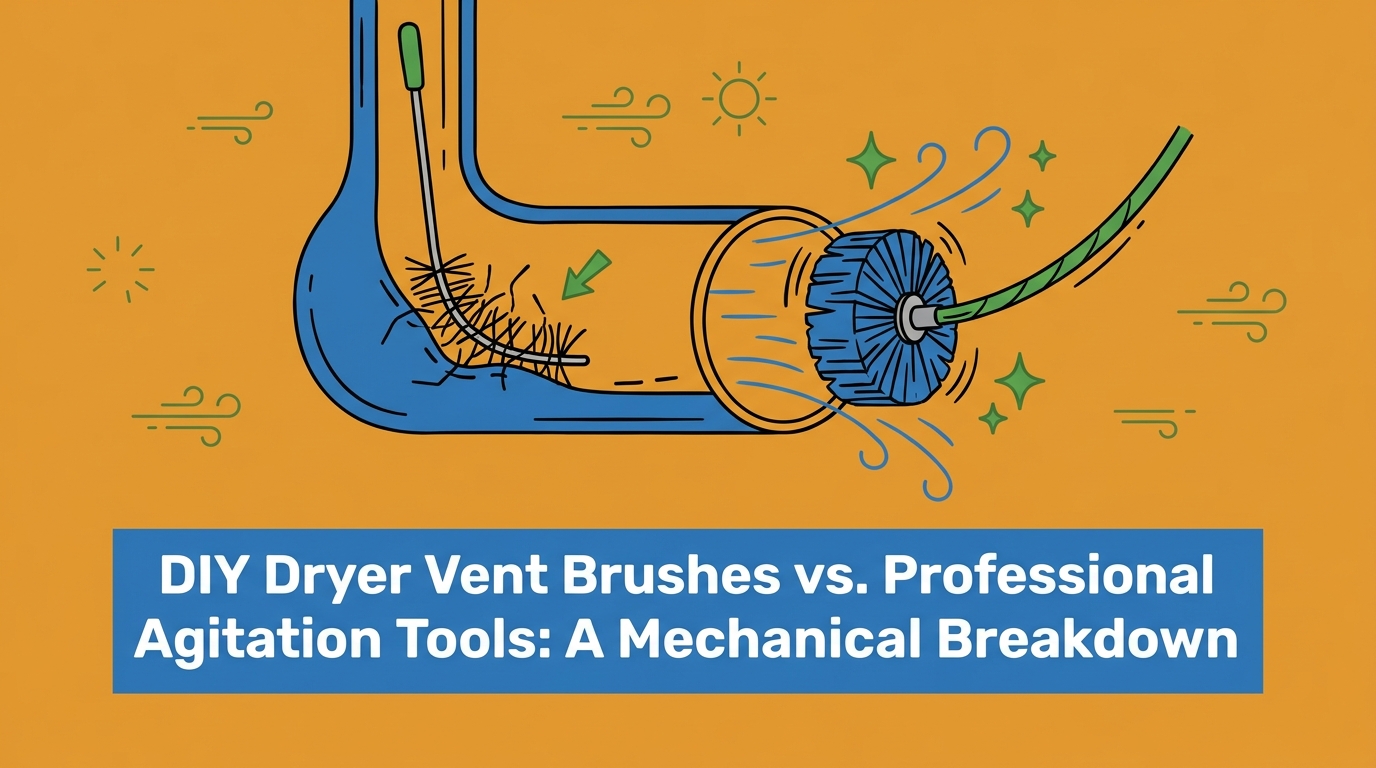
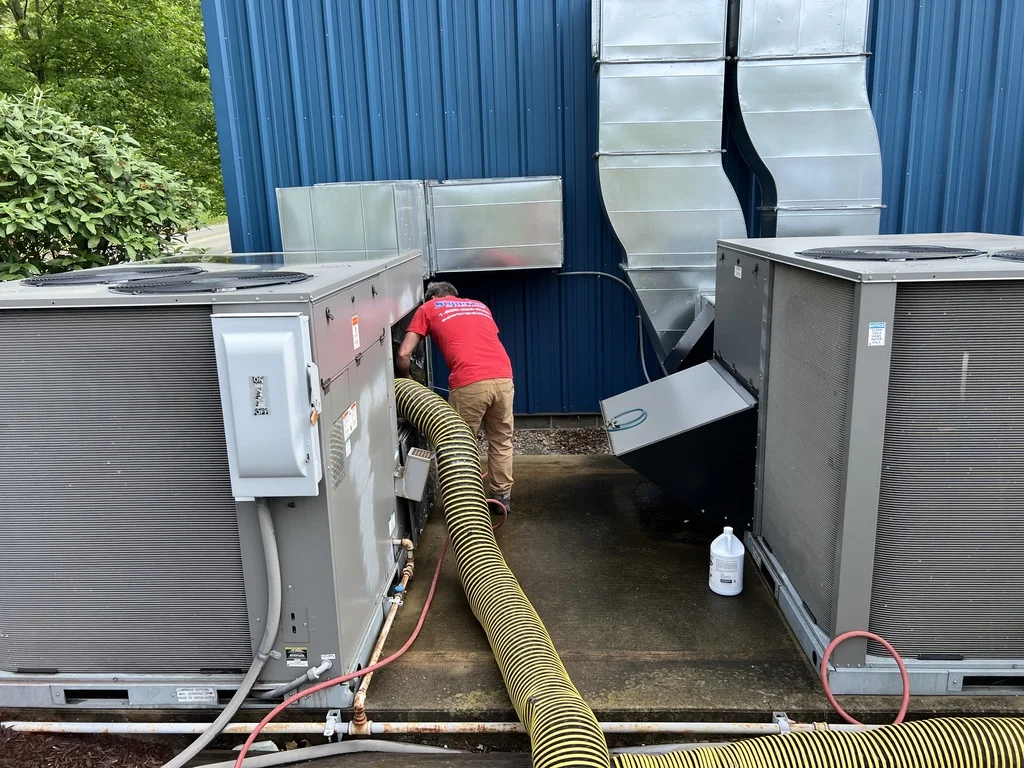
1. Source Removal: The system is placed under negative pressure, and specialized agitation tools physically scrub the dirt, dust, and debris out of the ducts. You cannot sanitize dirt; the surface must be clean first.
2. Equipment Calibration: Technicians calculate the exact volume of your ductwork to determine the precise concentration of the EPA-registered treatment required.
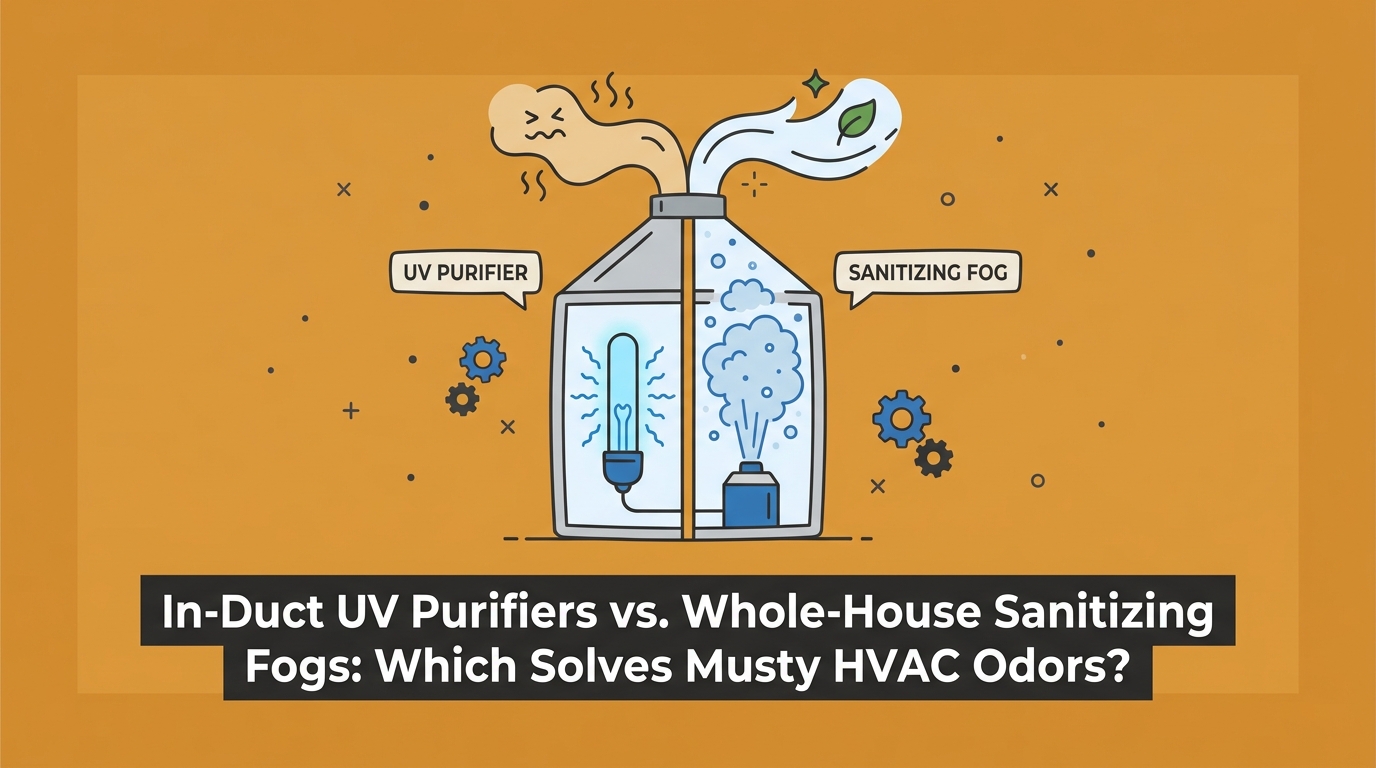
3. Ultra-Low Volume Fogging: Using specialized fogging equipment, the liquid treatment is atomized into microscopic droplets. This fog is drawn through the entire system by the HVAC fan or a negative air machine, ensuring complete, even coverage without oversaturating the metal or fiberglass components.
4. Dwell Time and Verification: The treatment is allowed to sit for the required dwell time to ensure total cellular destruction of the microbes before the system is returned to normal operation.
Consider a recent scenario our crew handled involving a rental property that suffered from horrible, lingering vent smells. The issue was not solved with store-bought sprays. It was only resolved when our professional team thoroughly vacuumed, cleaned, and properly sanitized the entire vent system and furnace. This is exactly why we at Superior Air Duct Cleaning rely exclusively on safe, proven, EPA-registered treatments to address the root cause, never using cheap masking agents. We always recommend investing in professional whole house sanitizing to guarantee the job is done safely and correctly.
Secure Your Home's Air Quality Before Winter
A clear, scientific approach to indoor air quality always beats a chemical band-aid. As we move deeper into the early fall heating-season transition, now is the time to ensure your home is a safe, healthy environment. Safely reducing mold and bacteria at the source before you seal your house up for the winter prevents respiratory irritation and eliminates embarrassing musty odors. We highly recommend scheduling a professional inspection and sanitizing treatment with Superior Air Duct Cleaning today to ensure your family breathes easier all season long.
Frequently Asked Questions
Why does my heater smell musty when I first turn it on in the fall?
The musty smell is caused by dormant biological growth that accumulated in your ductwork during the humid summer months. When you turn on the furnace, the sudden blast of hot air vaporizes this microbial matter and pushes the resulting odors into your living space. The smell usually indicates that your ducts need to be physically cleaned and sanitized by a professional to remove the underlying mold or bacteria.
Is it safe to use air fresheners or deodorizers in HVAC vents?
No, we do not recommend using commercial air fresheners or deodorizers inside your HVAC vents. These products often emit Volatile Organic Compounds (VOCs) that degrade indoor air quality and can trigger asthma, allergies, and respiratory irritation. They only mask the odor temporarily and do absolutely nothing to resolve the biological growth causing the smell.
What exactly is an EPA-registered antimicrobial treatment?
An EPA-registered antimicrobial treatment is a specialized solution that has passed rigorous scientific testing by the Environmental Protection Agency. This registration proves the product is highly effective at destroying specific pathogens, such as mold and bacteria, at the cellular level. It also verifies that the product is completely safe for use in residential HVAC systems when applied by a trained professional.
Can I just spray Lysol in my air vents to kill the smell?
Spraying household disinfectants into your air vents is strongly discouraged. Aerosol sprays only reach the first few inches of the ductwork, completely missing the deep trunk lines where the actual growth lives. Additionally, many household sprays contain flammable propellants that pose a significant fire hazard when pulled across a hot furnace heat exchanger.
How long does a professional duct sanitizing treatment last?
When applied correctly by our technicians after a thorough physical cleaning, a professional duct sanitizing treatment provides long-lasting results. Because the treatment destroys the existing biological growth at the cellular level, the musty odors are permanently neutralized. The system will remain clean and odor-free until new dirt and moisture are allowed to accumulate, which typically takes years with proper HVAC maintenance.
What is the difference between duct cleaning and sanitizing?
Duct cleaning is the physical process of using negative pressure and agitation tools to compressed-air tool and vacuum away dirt, dust, and debris from inside the ductwork. Sanitizing is the secondary step of applying an EPA-registered antimicrobial fog to neutralize any remaining microscopic mold, bacteria, or biological threats. You must perform a physical cleaning first, as you cannot effectively sanitize a surface that is covered in heavy dirt.

Customer Reviews


Superior Air Duct cleaning did a phenomenal job in a timely manner with the tech “Rich” being very professional ,personable and considerate of our property! He explained things as he proceeded and answered all our questions!
I LOVE that they provide before & after photos to see the difference. Give them a try… you won’t regret it
Pam T.
Robert was on schedule and communicated what time he would arrive. He was polite, professional, and respectful of our home. I wanted to wait a couple weeks before posting a review because I wanted to see if the duct cleaning actually made a difference. I am happy to say it did! I vacuum multiple times a week and have already noticed a significant reduction in the amount of dust cleaned up each time. As a home with pets, there will always be something to clean, but getting the ducts cleaned has definitely helped improve the air quality and reduce the dust.
alice A.
Technician Rob arrived early explained the days agenda and then proceeded to work methodically and meticulously over the next 6+ hours cleaning my ductwork. Courteous and professional they answered all of my questions and went above and beyond the call of duty. They even located an old dusty box of rat poison buried in our vents. My only regret is not finding these guys sooner. As a realtor of 22 years and owner of a newly purchased (now dust free) home I highly recommended!
Eric K.
Excellent service! I’ve used them to clean out my air ducts as well as my dryer vent duct and they are excellent. I was very pleased with both jobs and will continue to use them in the future. Great communication as well- from the time I scheduled the appointment until they were at my door.
Erika C.
We had such an amazing experience with Superior Air Duct Cleaning. They were so nice and friendly and did an amazing job. I loved seeing the before and after pictures. Besides doing an amazing job cleaning our air ducts they were so quick at responding and setting up the appointment. We will definitely be using them in the future.
Amanda C.