The Hidden Airflow Problem in Cranberry Township's Newest Homes
Your air conditioner is running nonstop, but the upstairs bedrooms still feel warm, and a fine layer of white dust keeps reappearing on your brand-new furniture. At Superior Air Duct Cleaning, our team frequently sees how navigating duct layouts in Cranberry Township's suburban new builds reveals an unexpected challenge: modern architecture often traps hidden debris right from the start. You might expect a freshly constructed house to have pristine indoor air, but the reality we encounter in the field is often the exact opposite. Modern construction trends heavily prioritize energy efficiency and airtight building envelopes. While this keeps your utility bills manageable, it ironically traps airborne construction debris inside the home if the ventilation system is not properly managed by professionals before move-in.
This hidden airflow problem usually reaches a breaking point during the late summer back-to-school transition. By this time of year, your HVAC system has been running on maximum cooling for months, circulating and recirculating trapped particulate matter through the house. The airflow becomes noticeably uneven, and standard cleaning methods simply cannot reach the deep blockages causing the restriction. To resolve these hidden issues and protect your new home's equipment, our experts recommend investing in professional air duct cleaning as the most effective way to restore your home's comfort and airflow.
The Frustration of a Dusty New Home
Moving into a new build is supposed to be a fresh start. You have untouched carpets, freshly painted walls, and brand-new appliances. Yet, many homeowners quickly report to us persistent allergy symptoms, strange odors from the vents, and a constant need to dust surfaces. This happens because the very system designed to keep you comfortable was operating while drywall was sanded, floors were cut, and cabinets were installed. Understanding why this happens requires looking past the drywall and examining the intricate network of ducts hidden in your ceilings and floors.
How Multi-Zone HVAC Systems Differ from Older Homes
When our technicians inspect homes built thirty or forty years ago in the New Brighton area, we typically find a traditional trunk-and-branch duct system. These older layouts are relatively straightforward: a large main trunk carries conditioned air from the furnace, and smaller branches distribute it to individual rooms. Air flows in one continuous direction with very few mechanical interruptions. However, modern construction demands higher efficiency and precise temperature control, leading to the widespread adoption of multi-zone HVAC duct layouts in newer homes.
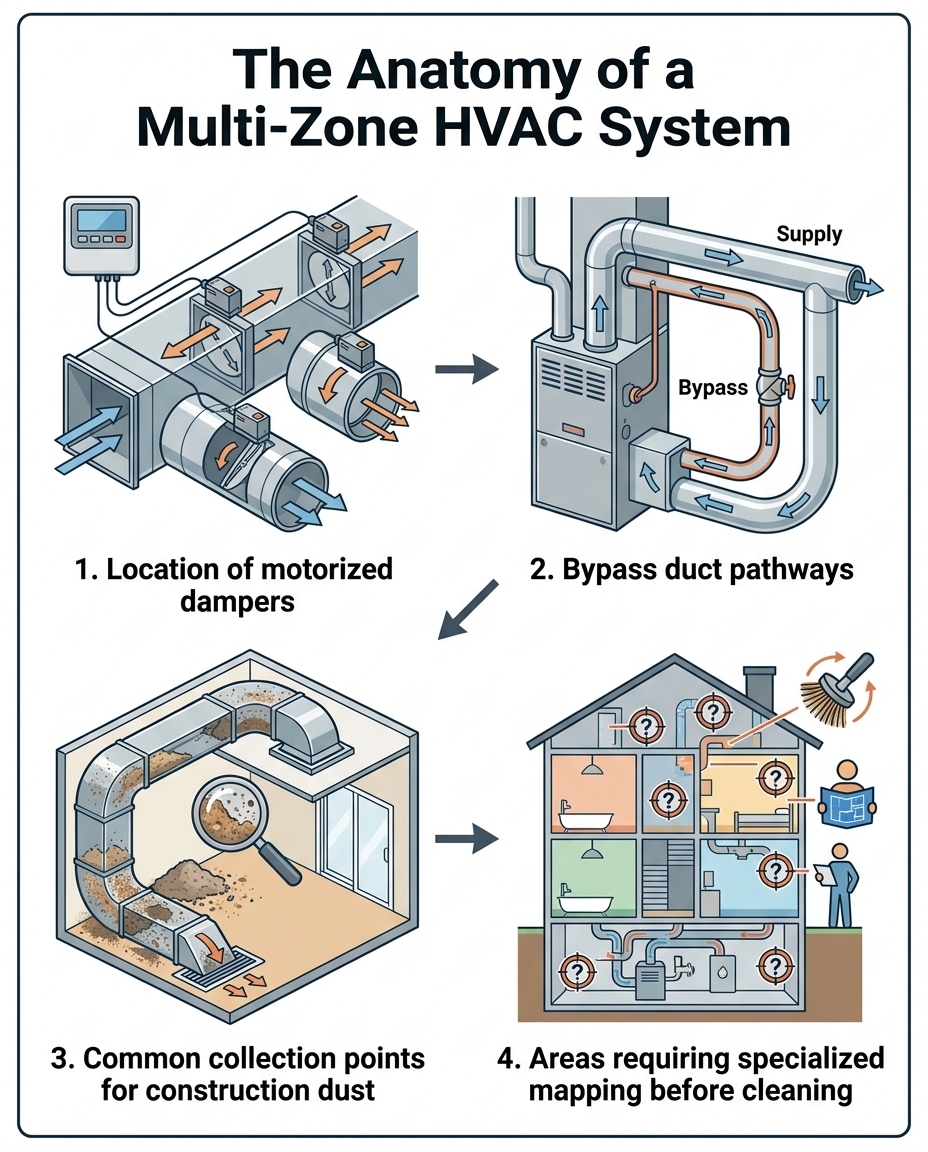
Multi-zone systems are vastly more complex. Instead of pushing air uniformly throughout the entire house, these systems divide your home into distinct climate zones—often separating the main living areas from the upper bedrooms. To achieve this, the ductwork relies on a network of motorized dampers and bypass ducts. These components actively open and close to direct airflow only where it is needed, which is excellent for energy savings but creates a labyrinth of physical barriers inside your ventilation system.
The Anatomy of Modern Ductwork
To understand why we see these modern systems trap debris so easily, it helps to look at the physical differences between the two designs:
• Airflow Control — Older Homes (Trunk & Branch): Continuous and unregulated across all open vents. — Modern New Builds (Multi-Zone): Segmented and actively managed by thermostats.
• Duct Complexity — Older Homes (Trunk & Branch): Straightforward main trunk with direct branches. — Modern New Builds (Multi-Zone): Intricate network with bypass routes and pressure reliefs.
• Internal Barriers — Older Homes (Trunk & Branch): Minimal (mostly static manual dampers). — Modern New Builds (Multi-Zone): Numerous motorized dampers that open and close.
• Dust Accumulation Risk — Older Homes (Trunk & Branch): Generally accumulates evenly over many years. — Modern New Builds (Multi-Zone): Traps heavy construction debris rapidly behind closed dampers.
Motorized dampers: These metal plates sit inside the ducts and pivot to block or allow airflow. When closed, they create a dead end where heavy dust particles slam into the metal and settle into a dense pile. Over months of construction, our crews find that these piles grow substantial.
Bypass ducts: When multiple zones close, the system builds up excessive static pressure. Bypass ducts relieve this pressure by looping air back to the return side of the furnace. Unfortunately, this loop also recirculates fine construction dust continuously, preventing it from ever settling out of the system.

Why Drywall Dust and Sawdust Linger Long After Move-In
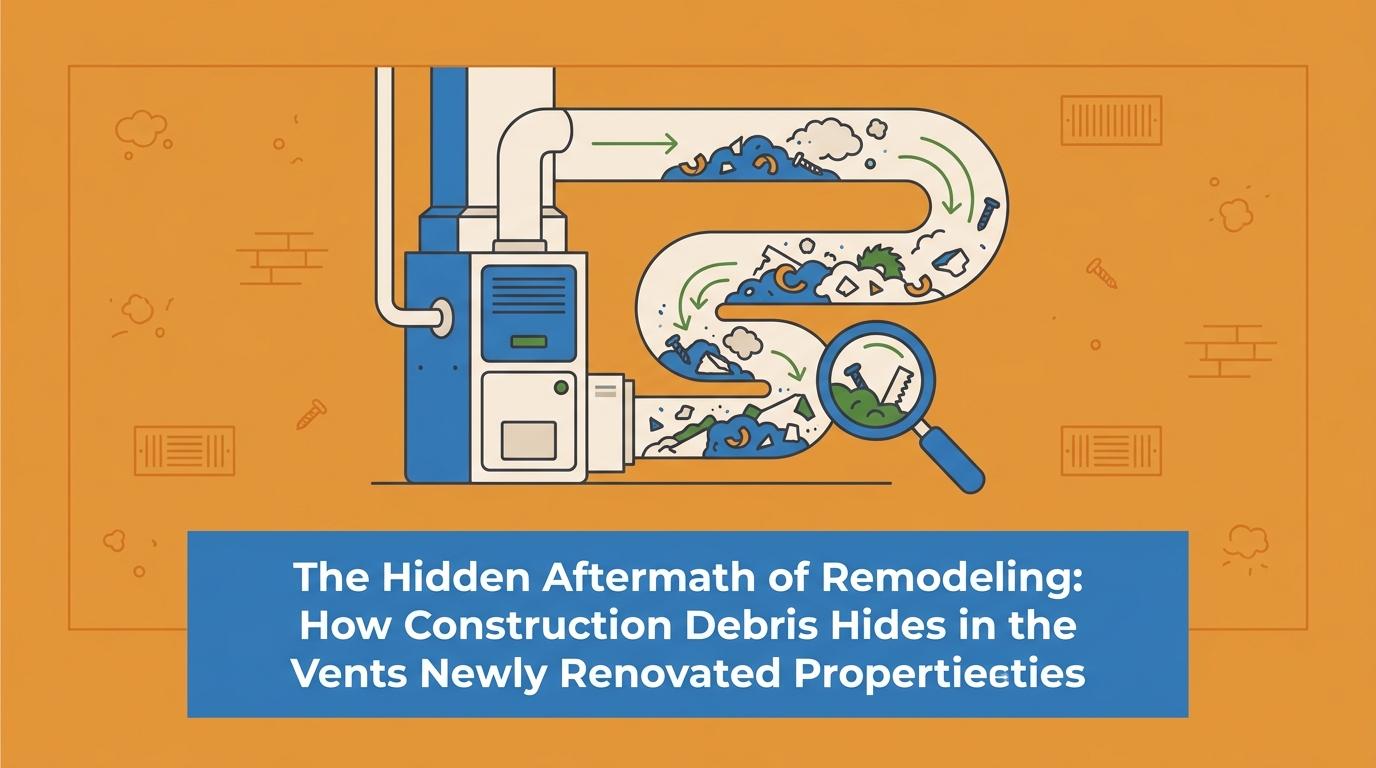
The construction phase of a new home is inherently messy. Contractors cut wood, sand drywall, spray texture, and install tile. During this process, the HVAC system is frequently turned on to provide climate control for the workers or to help cure paint and joint compound. As the blower motor pulls air from the house, it also vacuums up millions of fine particulate matter directly into the return ducts.
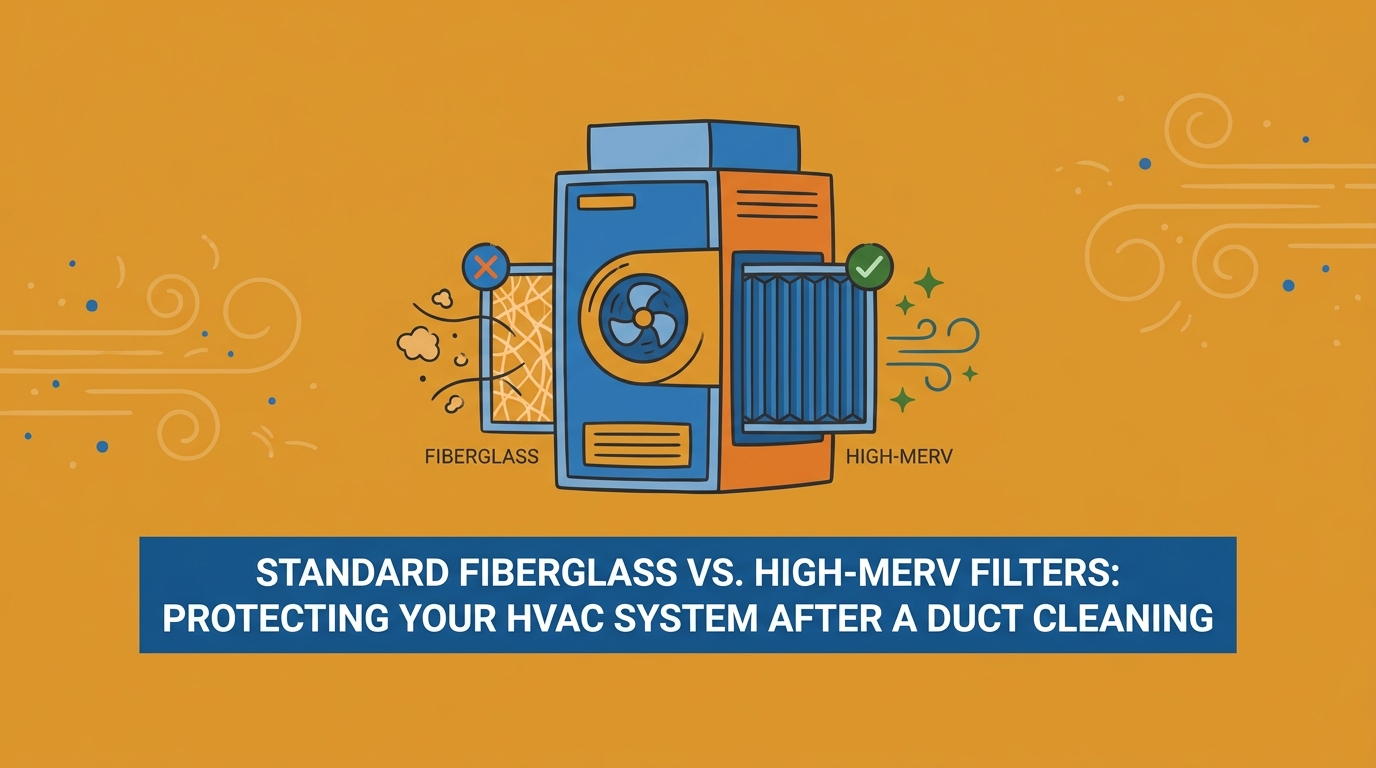
Standard fiberglass or pleated air filters are simply not designed to capture industrial-grade construction dust. Our team regularly pulls pounds of this debris out of new builds. Drywall dust is an ultra-fine, abrasive powder that easily bypasses standard residential filters, coating the blower wheel, the evaporator coil, and the interior walls of the supply ducts. Sawdust, being heavier, tends to drop into floor registers and collect at the bottom of vertical duct drops. Because this debris sits deep within the system, you cannot remove it with a household vacuum or by simply wiping down the vent covers.
The Real-World Impact on Your Home
The presence of this hidden debris has a profound impact on daily life. Homeowners frequently report severe allergy flare-ups, persistent coughing, and difficulty sleeping during their first few months in a new build. Recently, our crew helped a local homeowner managing a recently constructed rental property who experienced horrible vent smells and severe indoor air quality issues shortly after move-in. Once our team thoroughly vacuumed, cleaned, and sanitized the vents—and checked the furnace—the lingering odors were completely resolved, proving that the source of the problem was buried deep within the ductwork.
This is a widespread issue in rapidly developing areas like the Cranberry Township northern suburbs, where entire neighborhoods are constructed simultaneously. To truly protect your family's health and comfort, exploring comprehensive indoor air quality solutions is a necessary step after the builders hand over the keys. Removing this specific type of debris requires the specialized agitation tools our team uses to break up the settled dust without damaging the flexible duct lines commonly found in modern attics.
Late Summer Humidity: A Catalyst for Clogged Ducts in Western PA
The timing of when you notice airflow issues is rarely a coincidence. As we transition into the late-summer back-to-school season in Western Pennsylvania, our technicians see firsthand how the high humidity interacts directly with the leftover construction debris inside your ventilation system, creating a perfect storm for restricted airflow. As the cooling season reaches its peak demand, your air conditioner works overtime to pull moisture out of the indoor air. This condensation process happens at the evaporator coil, which sits directly in the path of the airflow.
When humid air meets trapped, ultra-fine drywall dust, a physical and chemical reaction occurs. Drywall joint compound is essentially gypsum dust. When gypsum dust absorbs moisture from the humid summer air, it clumps together and hardens. Instead of remaining a loose powder that could potentially be blown out of the vents, it adheres to the duct walls, the blower motor blades, and the damper plates like a layer of plaster.
The Strain on Your HVAC Equipment
This plaster-like buildup severely restricts the physical space available for air to travel through. Just as the late summer back-to-school transition arrives and you need your system to perform flawlessly, the restricted airflow causes the equipment to choke. The blower motor has to work twice as hard to push the same volume of air, leading to increased energy consumption and premature wear on a brand-new, high-efficiency system—one that may have even qualified for general energy rebates during the building process.
• Uneven Cooling: Rooms furthest from the furnace receive barely a trickle of air, staying uncomfortably warm.
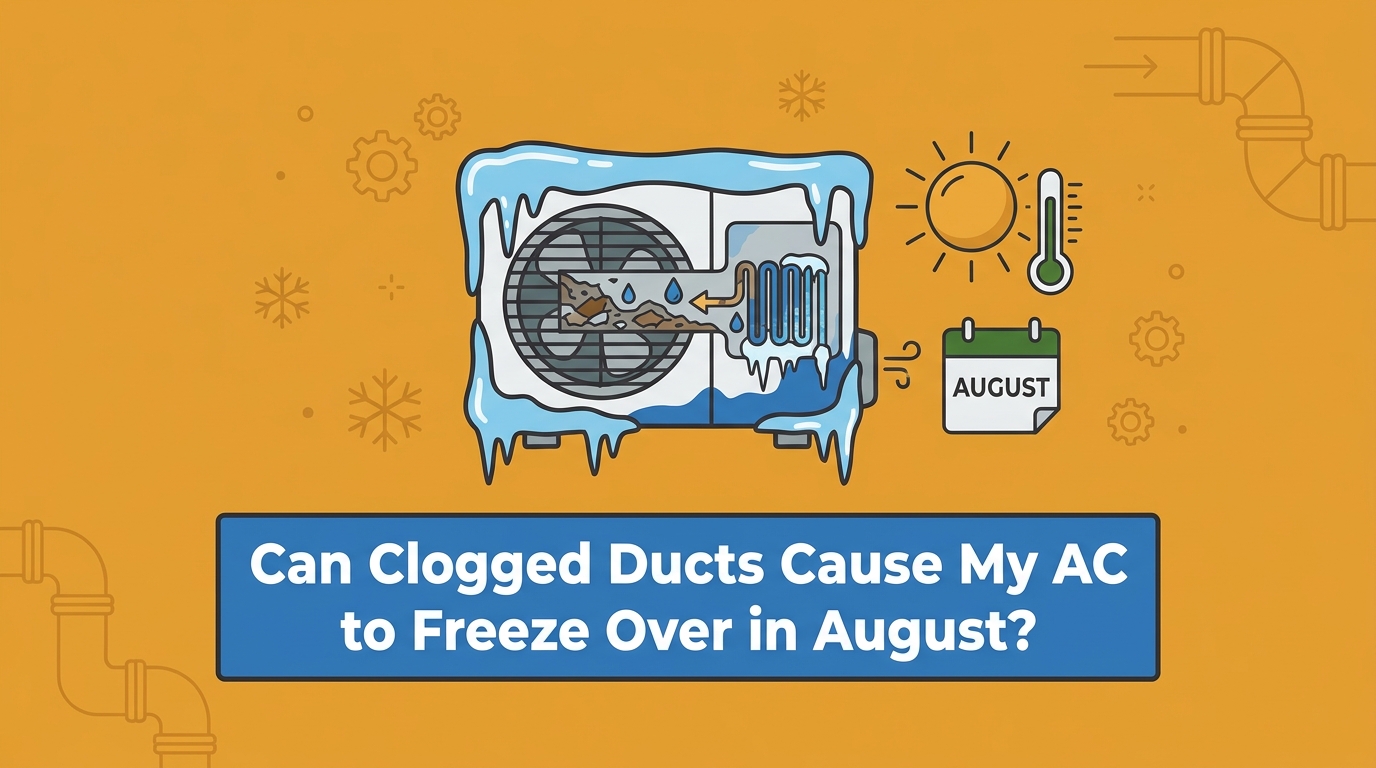
• Frozen Coils: Restricted airflow prevents the system from shedding cold air, causing the indoor coil to freeze solid.
• Short Cycling: The furnace may overheat and shut down prematurely because the heat cannot escape the heavily coated heat exchanger.
Ignoring this buildup does more than just make your home dusty; it actively strains the newly installed equipment that you paid a premium for during construction.
The Technical Necessity of System Mapping Before Cleaning
Because multi-zone HVAC duct layouts are so intricate, we always warn customers that standard "blow-and-go" duct cleaning methods are entirely ineffective—and potentially damaging. A standard cleaning involves hooking up a vacuum and blowing compressed air through the vents. If an untrained technician attempts this on a multi-zone system without preparation, the compressed air will simply slam the dust into a closed motorized damper, packing it tighter and potentially breaking the delicate damper motor.
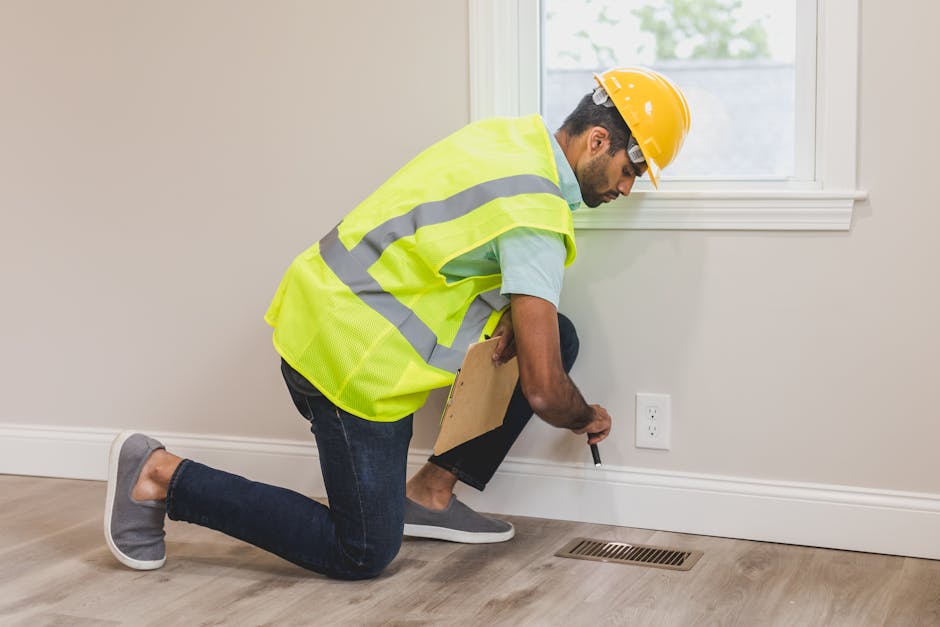
This is why system mapping is a critical first step for our technicians. System mapping is the meticulous process of tracing the entire duct layout before any cleaning equipment is turned on. A qualified technician must locate every hidden branch, identify the position of every motorized damper, and account for all bypass ducts. Our specific expertise at Superior Air Duct Cleaning in navigating and mapping complex multi-zone ductwork ensures complete removal of post-construction debris without causing harm to the system's mechanical components.
The Mapping and Cleaning Process
Properly servicing a new build requires a methodical approach. Here is how our certified technicians execute a mapped cleaning:
1. Blueprint Analysis and Tracing: Our technicians physically trace the duct lines from the basement or utility closet up through the floors, identifying where the main trunk splits into separate zones.
2. Damper Isolation: Every motorized damper is located. Our team coordinates with the thermostat controls to manually or electronically open all dampers, ensuring a clear path for the vacuum.
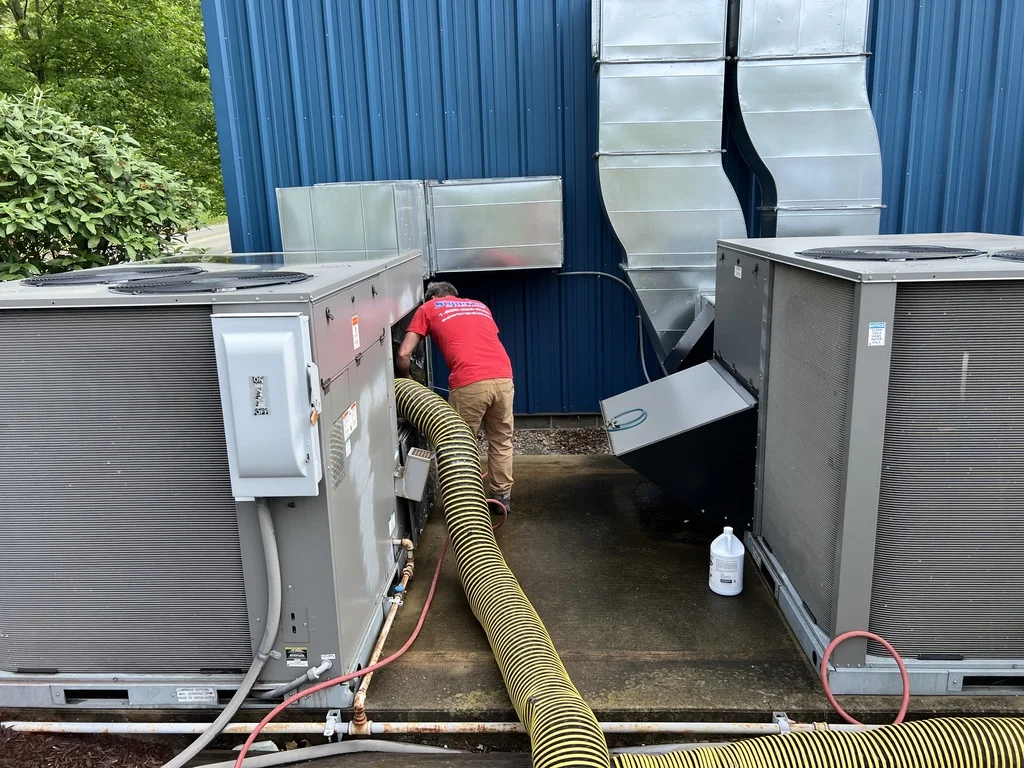
3. Bypass Duct Sealing: Bypass routes are temporarily sealed off by our crew so that negative pressure isn't lost in a continuous loop, ensuring maximum suction reaches the furthest vents.
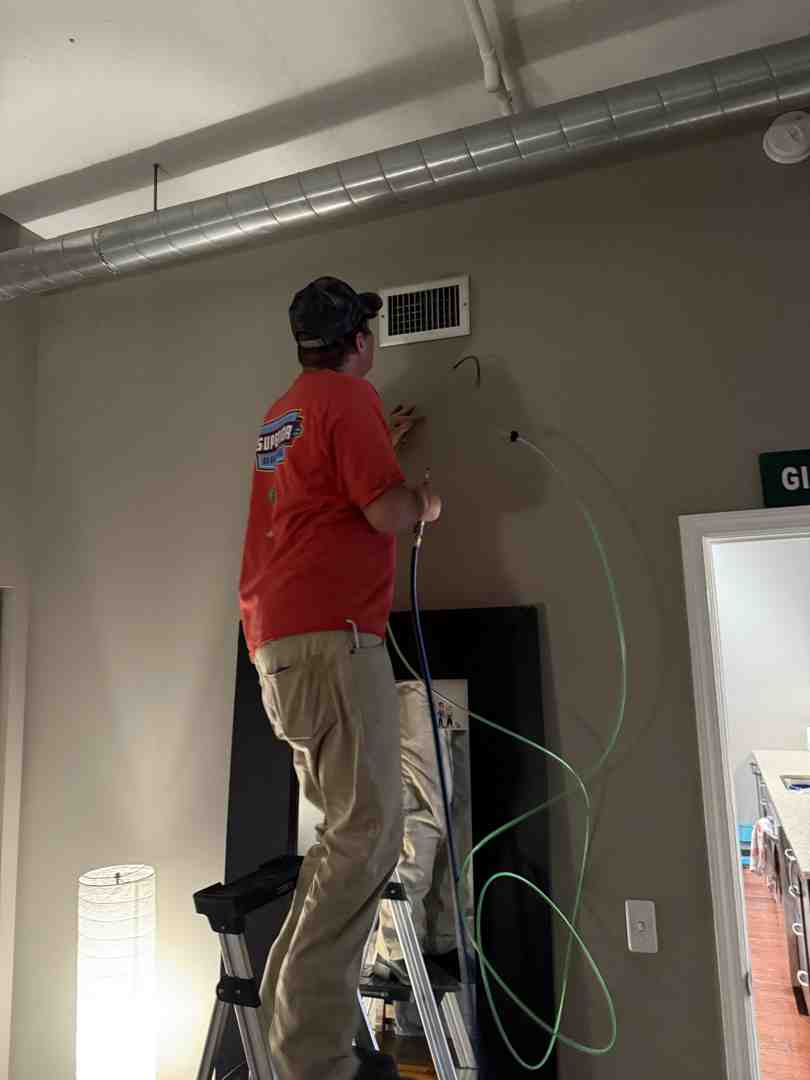
4. Targeted Agitation: Specialized air whips and compressed-air nozzles are fed through the newly opened pathways to break up the plaster-like drywall dust.
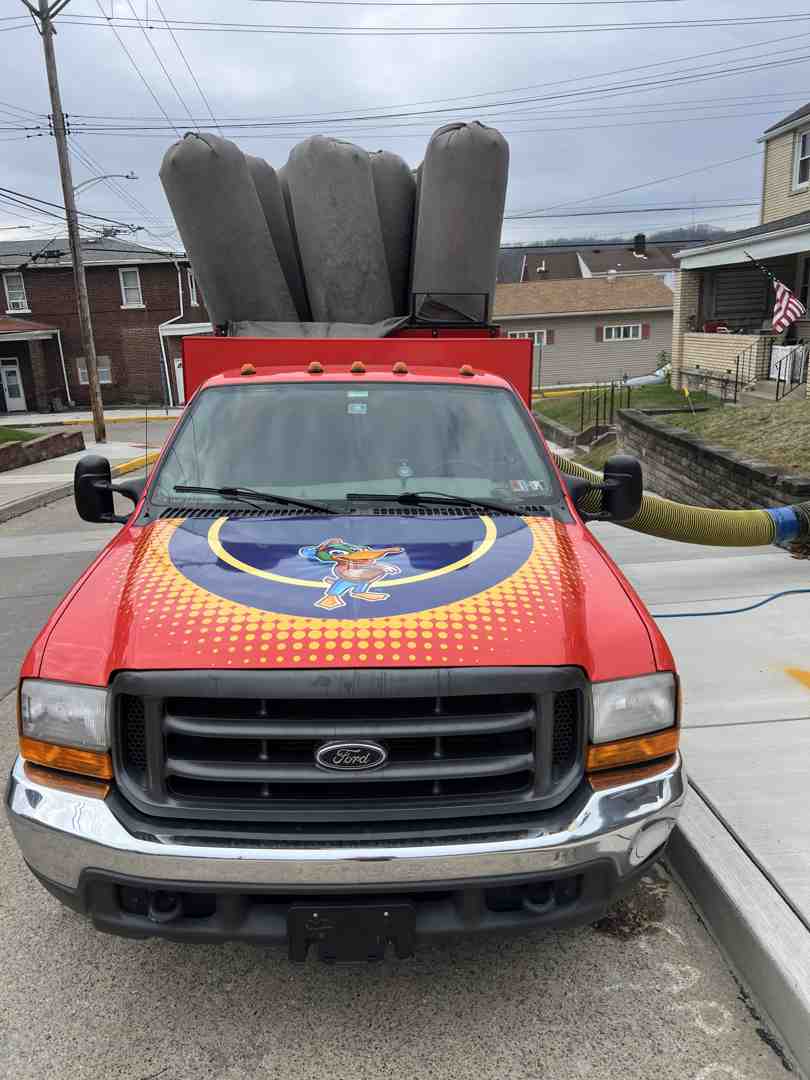
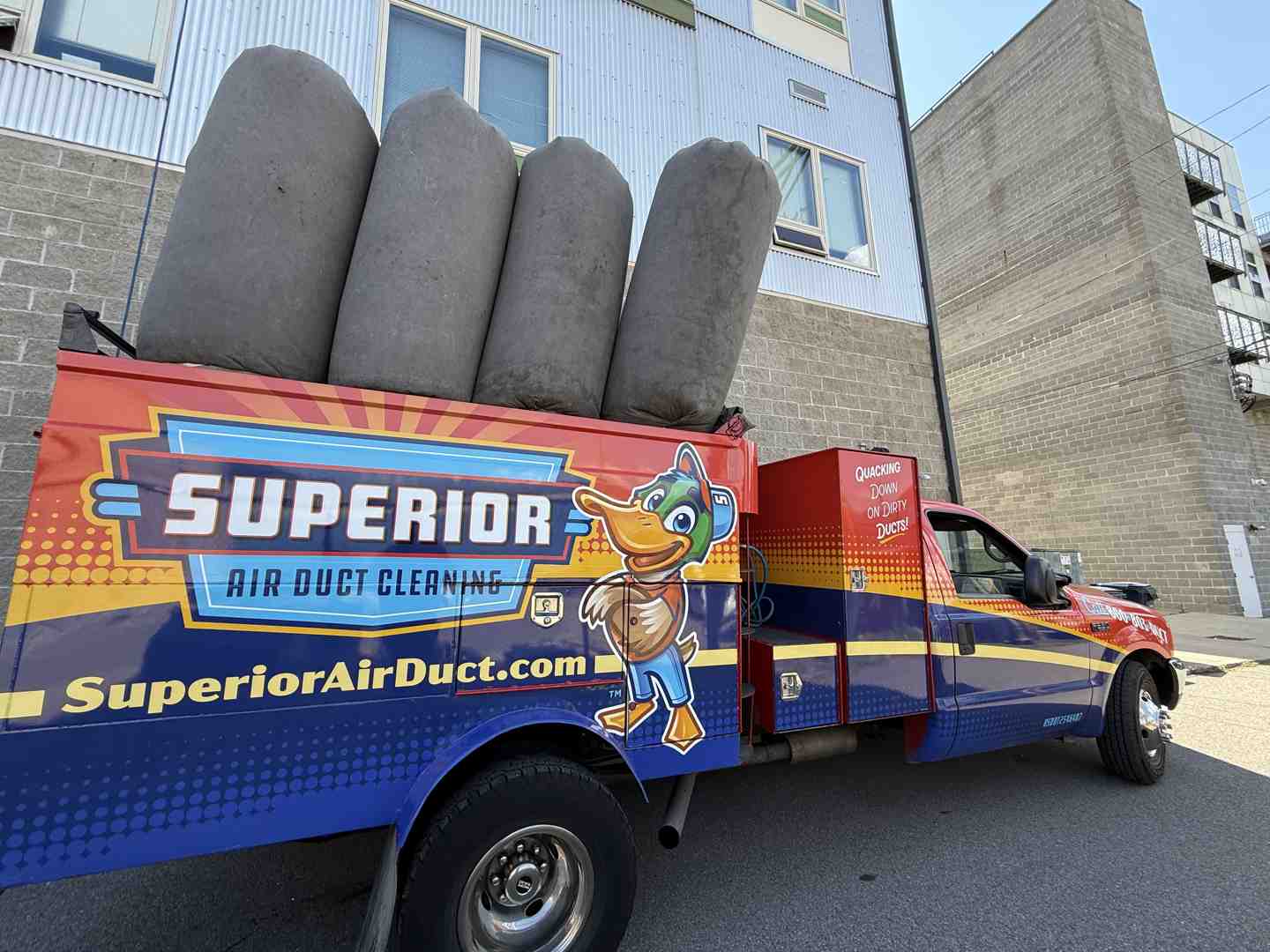
5. High-Powered Extraction: The loosened debris is pulled out of the home entirely. Depending on the home's layout, our technicians will determine the best equipment for the job, weighing the benefits of truck mounted vs portable duct cleaning systems to achieve the required negative pressure.
This level of professional precision guarantees that the hidden branches are thoroughly sanitized, rather than just pushing the dust deeper into unmapped zones.
EPA and NADCA Guidelines for Post-Construction HVAC Care
The necessity of post-construction duct cleaning isn't just an industry suggestion; it is backed by major environmental and air quality authorities. The National Air Duct Cleaners Association (NADCA) explicitly recommends that homeowners inspect and clean their HVAC systems after any significant construction or remodeling project. Their standards dictate that source removal—physically extracting the debris from the home under negative pressure—is the only acceptable method for restoring ductwork.
Furthermore, EPA guidelines regarding indoor air quality in new homes emphasize the importance of removing construction-related pollutants before occupancy. The EPA notes that fine particulate matter trapped in ventilation systems can circulate indefinitely if not professionally addressed, leading to long-term respiratory irritation and degraded indoor air quality.
Protecting Your Manufacturer Warranty
Beyond health and comfort, adhering to these industry standards is often required to protect the manufacturer warranties on your high-efficiency HVAC equipment. Most major furnace and air conditioner manufacturers explicitly state that equipment failure caused by dirt, dust, and neglect is not covered under warranty. If a blower motor burns out because it is caked in heavy drywall dust, the homeowner is often left footing the bill for a replacement part that should have lasted fifteen years.
Working with our local experts at Superior Air Duct Cleaning, who are deeply familiar with the building codes and architectural styles of the Cranberry Township northern suburbs, ensures that your system is treated according to these strict guidelines. Our professionals understand the specific layouts of these modern developments and are best equipped to navigate the complex ductwork, utilizing our knowledge of local service areas to provide targeted, compliant care.
Talk to an Expert About Your Cranberry Township New Build
Protecting the investment you've made in your new home requires specialized care for its most intricate systems. The hidden dust trapped inside your ductwork won't clear itself out, and standard filters are no match for the heavy construction debris left behind by builders. By prioritizing professional system mapping, you ensure that every hidden branch and motorized damper is accounted for, allowing your high-efficiency HVAC system to operate exactly as designed.
If you are tired of constantly dusting your new furniture or dealing with uneven cooling in your Cranberry Township northern suburbs home, it is time to take action. Reach out to Superior Air Duct Cleaning for an expert assessment of your new build's ductwork. A thorough, properly mapped cleaning by our team will provide true peace of mind, ensuring that the air your family breathes is as fresh and clean as the rest of your beautiful new home.
Frequently Asked Questions
Why is airflow uneven in my new construction home?
Uneven airflow in a new construction home is often caused by heavy construction debris blocking the ductwork. During the building process, fine drywall dust and sawdust are sucked into the open vents, where they settle behind motorized dampers and restrict the physical space air has to travel. This forces the HVAC system to work harder, leaving rooms furthest from the furnace feeling uncomfortably warm or cool.
Should you have air ducts cleaned after building a new house?
Yes, our team highly recommends having your air ducts cleaned after new construction in accordance with industry standards. Builders generate massive amounts of fine particulate matter, much of which ends up trapped inside the ventilation system before you even move in. A professional cleaning removes this abrasive dust, protecting your brand-new HVAC equipment from premature wear and significantly improving your indoor air quality.
How do multi-zone HVAC systems get cleaned?
Multi-zone HVAC systems require a specialized process called system mapping before they can be cleaned. Technicians like ours must locate and manually open all motorized dampers and temporarily seal bypass ducts to create a clear path for airflow. Once the system is mapped and opened, negative pressure vacuums and agitation tools are used to extract the dust without damaging the delicate mechanical components.
Can drywall dust ruin an HVAC system?
Drywall dust can cause severe damage to an HVAC system if left unaddressed. It is an ultra-fine, abrasive powder that easily bypasses standard air filters, coating the blower motor wheel and the indoor evaporator coil. Over time, this buildup throws the motor off balance, restricts airflow, and can cause the system to freeze up or overheat, potentially voiding the manufacturer's warranty.
How do you clean construction dust out of air vents?
Cleaning construction dust out of air vents requires professional source removal techniques using negative pressure. A household vacuum cannot reach deep enough into the ductwork, and simply wiping the vent covers only addresses the surface. Our professionals seal the system, attach a high-powered vacuum to the main trunk, and use specialized whips to agitate and extract the heavy dust from deep inside the hidden branches.
How long does it take to properly map and clean a multi-zone duct system?
For our team, properly mapping and cleaning a multi-zone duct system typically takes between three to five hours, depending on the size of the home and the complexity of the layout. The technician must spend time tracing the ductwork, locating the motorized dampers, and ensuring the system is safely prepared before the actual extraction begins. This meticulous preparation ensures a thorough cleaning without damaging the new equipment.

Customer Reviews


Superior Air Duct cleaning did a phenomenal job in a timely manner with the tech “Rich” being very professional ,personable and considerate of our property! He explained things as he proceeded and answered all our questions!
I LOVE that they provide before & after photos to see the difference. Give them a try… you won’t regret it
Pam T.
Robert was on schedule and communicated what time he would arrive. He was polite, professional, and respectful of our home. I wanted to wait a couple weeks before posting a review because I wanted to see if the duct cleaning actually made a difference. I am happy to say it did! I vacuum multiple times a week and have already noticed a significant reduction in the amount of dust cleaned up each time. As a home with pets, there will always be something to clean, but getting the ducts cleaned has definitely helped improve the air quality and reduce the dust.
alice A.
Technician Rob arrived early explained the days agenda and then proceeded to work methodically and meticulously over the next 6+ hours cleaning my ductwork. Courteous and professional they answered all of my questions and went above and beyond the call of duty. They even located an old dusty box of rat poison buried in our vents. My only regret is not finding these guys sooner. As a realtor of 22 years and owner of a newly purchased (now dust free) home I highly recommended!
Eric K.
Excellent service! I’ve used them to clean out my air ducts as well as my dryer vent duct and they are excellent. I was very pleased with both jobs and will continue to use them in the future. Great communication as well- from the time I scheduled the appointment until they were at my door.
Erika C.
We had such an amazing experience with Superior Air Duct Cleaning. They were so nice and friendly and did an amazing job. I loved seeing the before and after pictures. Besides doing an amazing job cleaning our air ducts they were so quick at responding and setting up the appointment. We will definitely be using them in the future.
Amanda C.