The Alarming Statistics Behind Townhome Dryer Fires
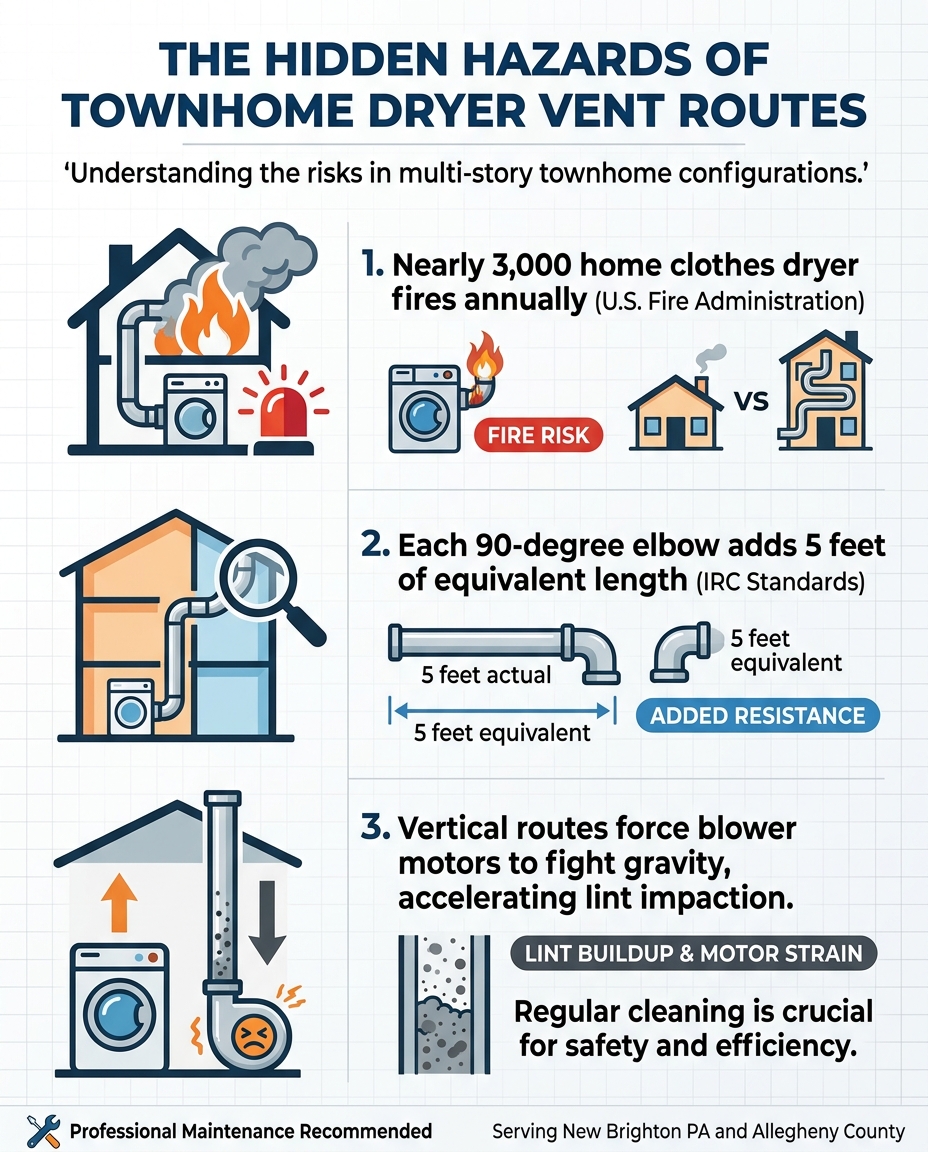
Nearly 3,000 home clothes dryer fires are reported annually by the U.S. Fire Administration, and the leading cause is a simple failure to clean the exhaust ducts. At Superior Air Duct Cleaning, we know firsthand that tackling dryer vent routes in multi-story townhomes across Allegheny County requires understanding that these properties face unique architectural challenges. Unlike a standard single-story house where the vent punches straight through an exterior wall just a few feet away, townhomes utilize complex, highly restrictive exhaust paths. When your dryer starts taking two or three cycles to dry a single load of towels, you are not just dealing with an appliance issue. You are seeing the first major warning sign of a severe blockage. Addressing this hazard requires specialized attention to maintain proper indoor air quality and eliminate the risk of a devastating fire.
The hidden dangers of complex architecture: Most homeowners do not realize how quickly lint builds up when the exhaust air has to travel long distances. In our years of servicing Allegheny County multi-story townhome developments, our team has noticed that the structural design frequently prioritizes living space over utility access. This means laundry rooms are often placed in the center of the home or on the second floor, forcing the exhaust to take a long, winding path to the outside. As the air travels further, it loses velocity, dropping heavy, wet lint along the interior walls of the ductwork.
To understand the difference in risk, consider how townhome layouts compare to traditional single-family homes:
• Vent Route Length — Standard Single-Family Home: Typically under 10 feet, straight path. — Multi-Story Townhome: Often 20 to 35+ feet, multiple bends.
• Exit Point — Standard Single-Family Home: Ground-level exterior wall. — Multi-Story Townhome: High roofline or distant exterior wall.
• Airflow Resistance — Standard Single-Family Home: Minimal. Exhaust exits quickly. — Multi-Story Townhome: High. Gravity and elbows slow air down.
• Lint Accumulation Rate — Standard Single-Family Home: Gradual buildup over years. — Multi-Story Townhome: Rapid impaction, especially in vertical runs.
When you recognize the structural disadvantages built into these homes, it becomes clear why routine maintenance is not just a suggestion, but an absolute necessity for property safety.
Fighting Gravity: The Physics of Vertical Roof Exhaust Routing
Many modern townhome developments are designed to maximize every square inch of living space, which often results in laundry rooms being placed far away from exterior walls. When our technicians inspect these properties around New Brighton and the greater county area, we frequently see builders installing vertical roof exhaust routing systems to solve this architectural puzzle. While this solves the space issue, it creates a massive mechanical burden on your appliance. A vertical vent forces the dryer's blower motor to constantly fight gravity to expel lint and moist air up through the ceiling, the attic, and finally out through the roof.
Because of this constant upward battle, lint accumulates exponentially faster than it would in a ground-floor laundry room with a short exterior wall vent. Heavy, wet lint struggles to make the vertical climb. As the blower motor pushes the air upward, the heaviest particles fall back down when the dryer turns off, settling at the base of the vertical climb. Over time, this heavy lint buildup chokes the airflow entirely. When the air cannot escape, the dryer overheats, internal safety thermostats fail, and the highly flammable lint becomes a significant fire risk.
How Distance Multiplies the Danger
Vertical runs are almost always much longer than standard wall vents, and that distance is the enemy of efficiency. The longer the distance the air must travel, the more energy the dryer expends just trying to push the moisture out of the house. This constant strain drastically reduces the lifespan of the appliance, leading to burned-out heating elements and failed blower motors.
• Reduced air velocity: As air travels up a vertical pipe, friction against the duct walls slows it down, causing lint to drop out of the airstream.
• Condensation buildup: Hot, moist air cools as it travels through unconditioned attic spaces, causing water to condense inside the duct and turn lint into a sticky paste.
• Complete blockages: Even a partial blockage in a vertical run can completely halt exhaust flow, as the restricted opening cannot overcome the gravitational pull on the exhaust air.
Understanding these physical limitations is crucial for homeowners who want to protect their property and extend the life of their laundry appliances.
Navigating Long Horizontal Joist Runs and 90-Degree Elbows
When vents are not routed straight up through the roof, they often travel horizontally across long floor joists to reach an exterior wall. In the Allegheny County multi-story townhome developments we service daily, these horizontal runs are notoriously complex. Because the ductwork must navigate around plumbing, electrical lines, and structural supports, it rarely travels in a straight line. Instead, the ductwork relies on multiple turns and bends to reach the outside.
According to International Residential Code (IRC) standards, every 90-degree elbow in a dryer vent run adds the equivalent of 5 feet to the total run length. This means that a vent that physically measures 15 feet long, but includes three 90-degree elbows, actually performs like a vent that is 30 feet long. The maximum allowable length for a standard dryer vent is typically 35 feet, meaning that just a few elbows can push a townhome's exhaust system dangerously close to—or beyond—its safe operational limits.
The hidden traps in your ductwork:
• Natural catch-points: Every elbow creates a turbulent zone where air swirls rather than flowing smoothly, causing lint to snag and build up rapidly.
• Sagging horizontal runs: Over time, horizontal ducts running between joists can sag if not properly supported, creating low spots where heavy, wet lint pools and hardens.
• Crushed transition hoses: The flexible hose connecting the dryer to the wall is often crushed when the appliance is pushed back, acting like an immediate 90-degree elbow right at the source.
In a multi-story townhome, a vent route might require several of these elbows just to get outside. This drastically reduces the effective airflow, causing the system to choke on its own exhaust. Recognizing these hidden architectural challenges is the first step in understanding why your dryer might be struggling.

The Impact of the Late-Summer Laundry Surge
The transition into late summer brings a heavy influx of laundry. As families prepare for the new school year, washing machines and dryers work overtime processing bulky jeans, heavy bedding, and fall clothing. This August back-to-school laundry surge drastically increases the amount of lint pushed into the exhaust system in a very short period. When you combine this sudden increase in volume with the existing structural challenges of a townhome, the results are highly predictable.
Western Pennsylvania's humid late summers play a major role in this process. The ambient humidity in the air combines with the moisture from wet clothes to create dense, heavy lint. Unlike the dry, fluffy lint you pull from the trap screen, this moisture-heavy lint clings stubbornly to the interior walls of vertical ductwork. It acts like papier-mâché, coating the inside of the pipe and slowly suffocating the exhaust flow.
This is the time of year when underlying clogs are finally exposed. Just this past August, our crew assisted a local homeowner who scheduled their routine 18-month maintenance during the summer laundry surge. They found that our thorough cleaning immediately resolved their airflow issues, proving that our prompt, honest service is the best defense against seasonal buildup. Often, the first sign of this dense impaction is a dryer that suddenly needs two or three full cycles just to dry a single load of towels. The appliance is generating heat, but because the moist air has nowhere to go, the clothes simply steam inside the drum.
Signs the summer surge has clogged your system:
• The laundry room becomes uncomfortably hot and humid while the dryer is running.
• The exterior of the dryer cabinet feels excessively hot to the touch.
• Towels and jeans take longer than 45 minutes to dry completely.
• The flapper valve on the outside of your home barely opens when the dryer is on.
Why DIY Brush Kits Fail in Multi-Story Townhomes
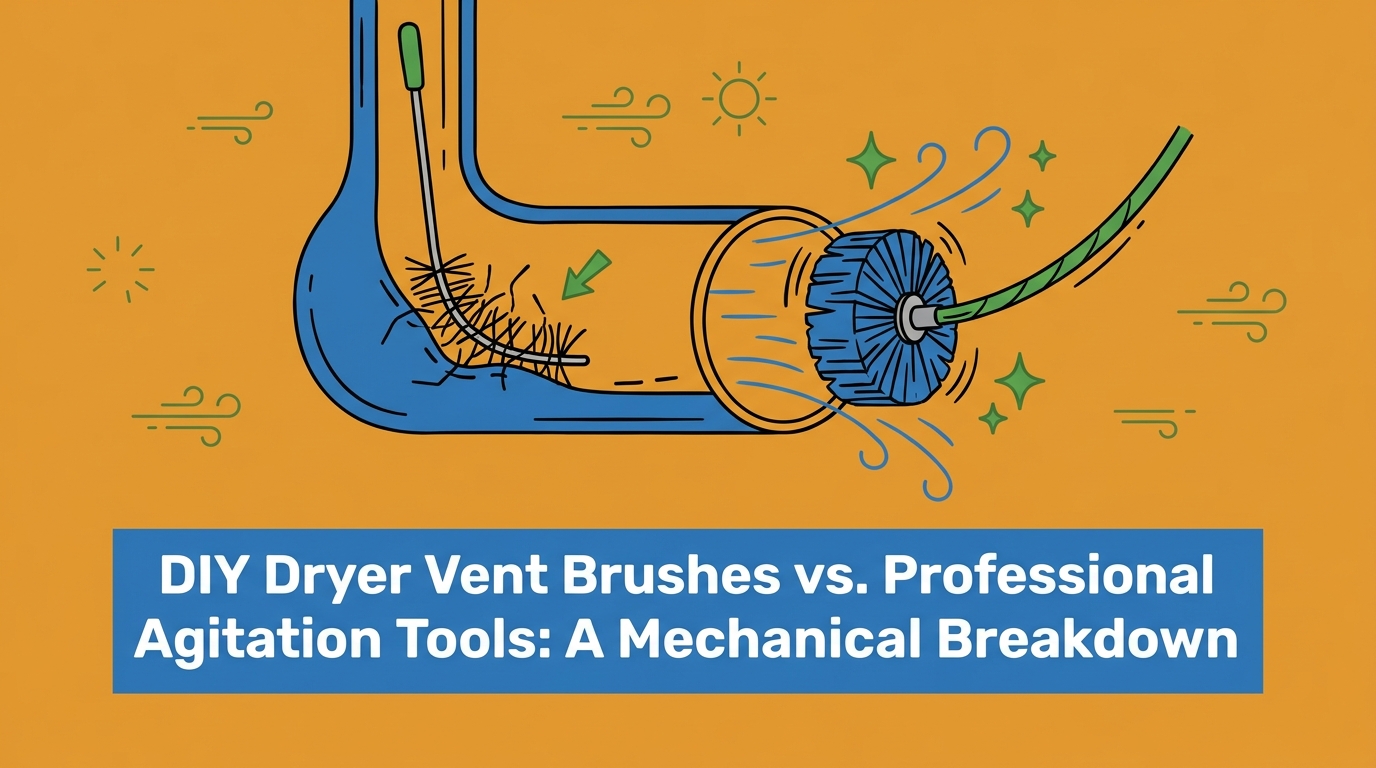
When faced with a slow-drying appliance, many homeowners head to the hardware store for a consumer-grade DIY brush kit. These kits usually consist of a plastic brush head and several flexible fiberglass rods that you attach to a power drill. While these tools might work for short, straight, ground-level exterior vents, they are entirely inadequate for complex architectural layouts. Attempting to use a standard brush kit on vertical roof exhaust routing systems or long horizontal joist runs is a recipe for disaster.
The primary issue is torque. As you push the compressed-air tool further into a long, winding duct, the resistance increases. When the compressed-air tool hits a 90-degree elbow or encounters a dense wall of hardened lint, the drill continues to spin, twisting the flexible rods until they snap. Once a rod snaps, the brush head becomes permanently lodged inside the ductwork, buried deep within your walls or ceiling.
A broken brush head creates an immediate, severe blockage that traps all future lint, rapidly escalating the fire hazard. Removing a stuck compressed-air tool often requires cutting into drywall or dismantling the ceiling, turning a simple maintenance task into a major home repair project. Recognizing the dangerous warning signs your dryer vent is clogged early is crucial to avoiding this costly DIY mistake.
Unlike consumer-grade tools that rely on fragile plastic rods, our technicians at Superior Air Duct Cleaning utilize specialized professional extraction equipment designed specifically to safely navigate complex vertical routes. Professional systems use high-volume negative air pressure combined with specialized agitation tools that will not break or damage delicate internal ductwork, ensuring the entire line is cleared safely.
The Superior Approach to Complex Dryer Vent Extraction
Safely clearing lint from vertical roof vents and long floor joists requires much more than a shop vacuum and a hardware store brush. It requires high-powered, professional-grade extraction equipment designed to handle the specific architectural challenges of Allegheny County multi-story townhome developments. Trained technicians understand how to navigate multiple 90-degree elbows, vertical climbs, and long horizontal stretches without damaging the delicate ductwork hidden behind your walls.
The professional process relies on placing the entire duct under negative pressure. By attaching a high-powered vacuum system to the line, technicians ensure that as the lint is agitated, it is immediately pulled out of the home rather than being pushed further into a compacted clog. This specialized equipment is essential for maintaining the safety and efficiency of properties across all Allegheny County service areas. A local customer reached out to us over the summer when their dryer ducts needed attention; our technician arrived in a timely manner, efficiently cleared the complex multi-story route, and left the ducts completely clean, demonstrating the value of our professional intervention.
Comprehensive Whole-Home Airflow Maintenance
Addressing the dryer vent is just one part of maintaining a healthy, safe home environment. Many homeowners find that combining vent extraction with broader duct maintenance improves overall HVAC efficiency and indoor air quality. When our professional technicians are on-site, we can assess the entire system, identifying areas where airflow is restricted.
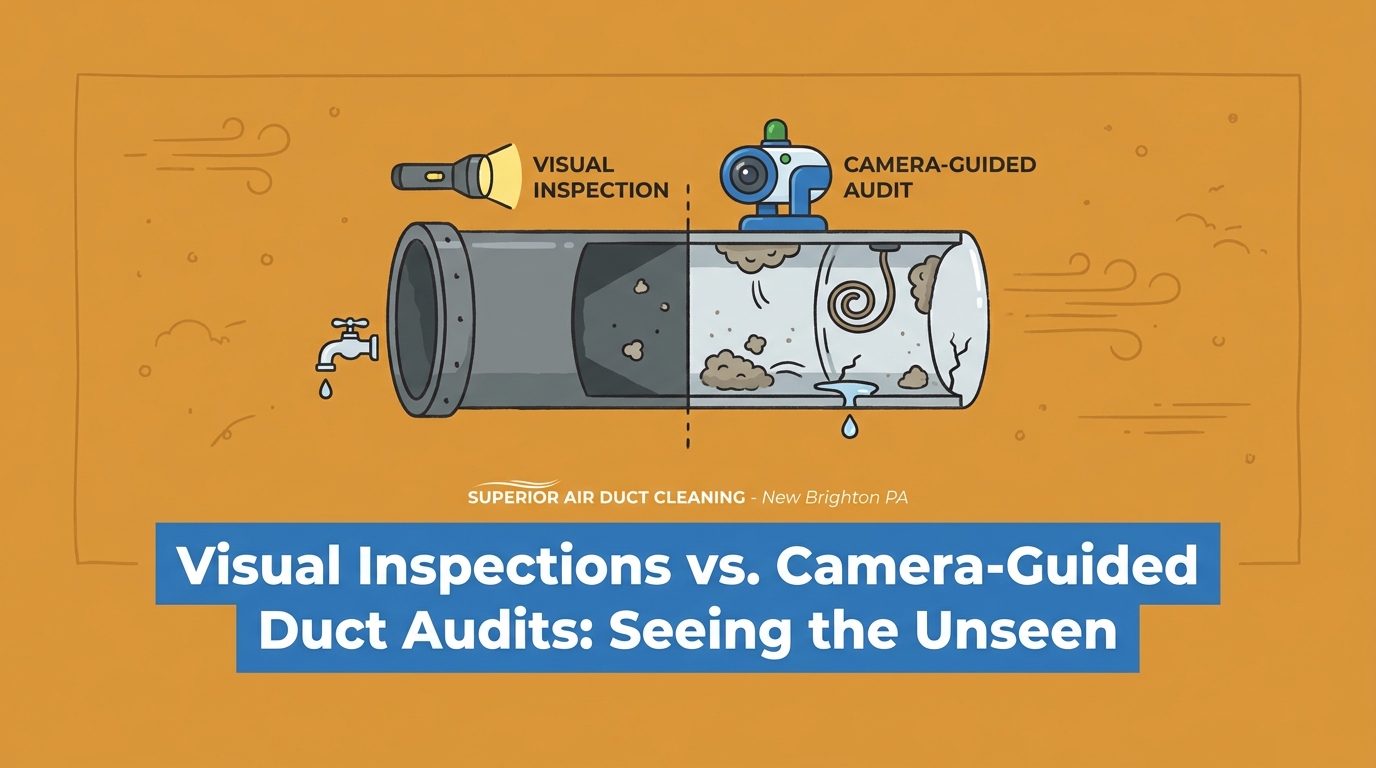
For townhome owners, coordinating residential air duct cleaning alongside your dryer vent maintenance ensures that your home's entire respiratory system is functioning optimally. Professional technicians provide a clear explanation of the process and often offer visual confirmation of the results, giving you absolute certainty that your home is safe from hidden hazards.
Protect Your Townhome Before the Fall Season
Understanding exactly why your townhome's specific vent layout causes severe fire hazards is the first step to protecting your property. The combination of vertical climbs, multiple elbows, and the August back-to-school laundry surge creates a perfect storm for rapid lint impaction. Don't wait for your dryer to overheat, trip a thermal fuse, or take three cycles to dry a single load of clothes.
Rely on our local experts at Superior Air Duct Cleaning, who are fully equipped to handle the architectural complexities of your multi-story home. By scheduling professional dryer vent cleaning, you ensure that your system is thoroughly and safely cleared, protecting your appliance, lowering your energy bills, and keeping your home safe from hidden fire risks all year long.
Frequently Asked Questions
Can I clean a dryer vent that goes to the roof?
Cleaning a vertical roof vent requires specialized high-powered extraction equipment, making it unsafe for DIY methods. Consumer-grade brush kits frequently snap and become lodged in vertical climbs, creating a severe fire hazard. We highly recommend hiring professionals who have the correct tools to navigate the distance and gravity involved.
Why does my dryer take multiple cycles to dry clothes?
When a dryer takes multiple cycles to dry clothes, it usually means the exhaust vent is severely restricted or completely clogged. The appliance is generating heat, but the moist air cannot escape, causing the clothes to simply steam inside the drum. This is a major warning sign of a fire hazard that requires immediate attention.
How do you clean a vertical dryer vent in a townhouse?
Our professionals clean vertical townhouse vents by placing the entire ductline under high-powered negative air pressure. While the vacuum pulls the air outward, specialized agitation tools are safely fed through the ductwork to break loose the heavy, wet lint stuck to the walls. This ensures the clog is completely removed without damaging the internal pipes.
What is the maximum length for a dryer vent run?
Most building codes specify a maximum dryer vent length of 35 feet, but this number decreases rapidly with every turn. According to standard building codes, every 90-degree elbow adds the equivalent of 5 feet to the total run length. In a townhome with multiple elbows, the safe physical length of the pipe is drastically reduced.
How often should Allegheny County townhomes have their dryer vents cleaned professionally?
Townhomes with complex, long, or vertical vent routes should have their dryer vents professionally cleaned at least once every 12 to 18 months. Homes that process heavy laundry loads, such as large families or those dealing with heavy seasonal clothing, may require cleaning even more frequently to prevent dangerous lint impaction.

Customer Reviews


Superior Air Duct cleaning did a phenomenal job in a timely manner with the tech “Rich” being very professional ,personable and considerate of our property! He explained things as he proceeded and answered all our questions!
I LOVE that they provide before & after photos to see the difference. Give them a try… you won’t regret it
Pam T.
Robert was on schedule and communicated what time he would arrive. He was polite, professional, and respectful of our home. I wanted to wait a couple weeks before posting a review because I wanted to see if the duct cleaning actually made a difference. I am happy to say it did! I vacuum multiple times a week and have already noticed a significant reduction in the amount of dust cleaned up each time. As a home with pets, there will always be something to clean, but getting the ducts cleaned has definitely helped improve the air quality and reduce the dust.
alice A.
Technician Rob arrived early explained the days agenda and then proceeded to work methodically and meticulously over the next 6+ hours cleaning my ductwork. Courteous and professional they answered all of my questions and went above and beyond the call of duty. They even located an old dusty box of rat poison buried in our vents. My only regret is not finding these guys sooner. As a realtor of 22 years and owner of a newly purchased (now dust free) home I highly recommended!
Eric K.
Excellent service! I’ve used them to clean out my air ducts as well as my dryer vent duct and they are excellent. I was very pleased with both jobs and will continue to use them in the future. Great communication as well- from the time I scheduled the appointment until they were at my door.
Erika C.
We had such an amazing experience with Superior Air Duct Cleaning. They were so nice and friendly and did an amazing job. I loved seeing the before and after pictures. Besides doing an amazing job cleaning our air ducts they were so quick at responding and setting up the appointment. We will definitely be using them in the future.
Amanda C.